
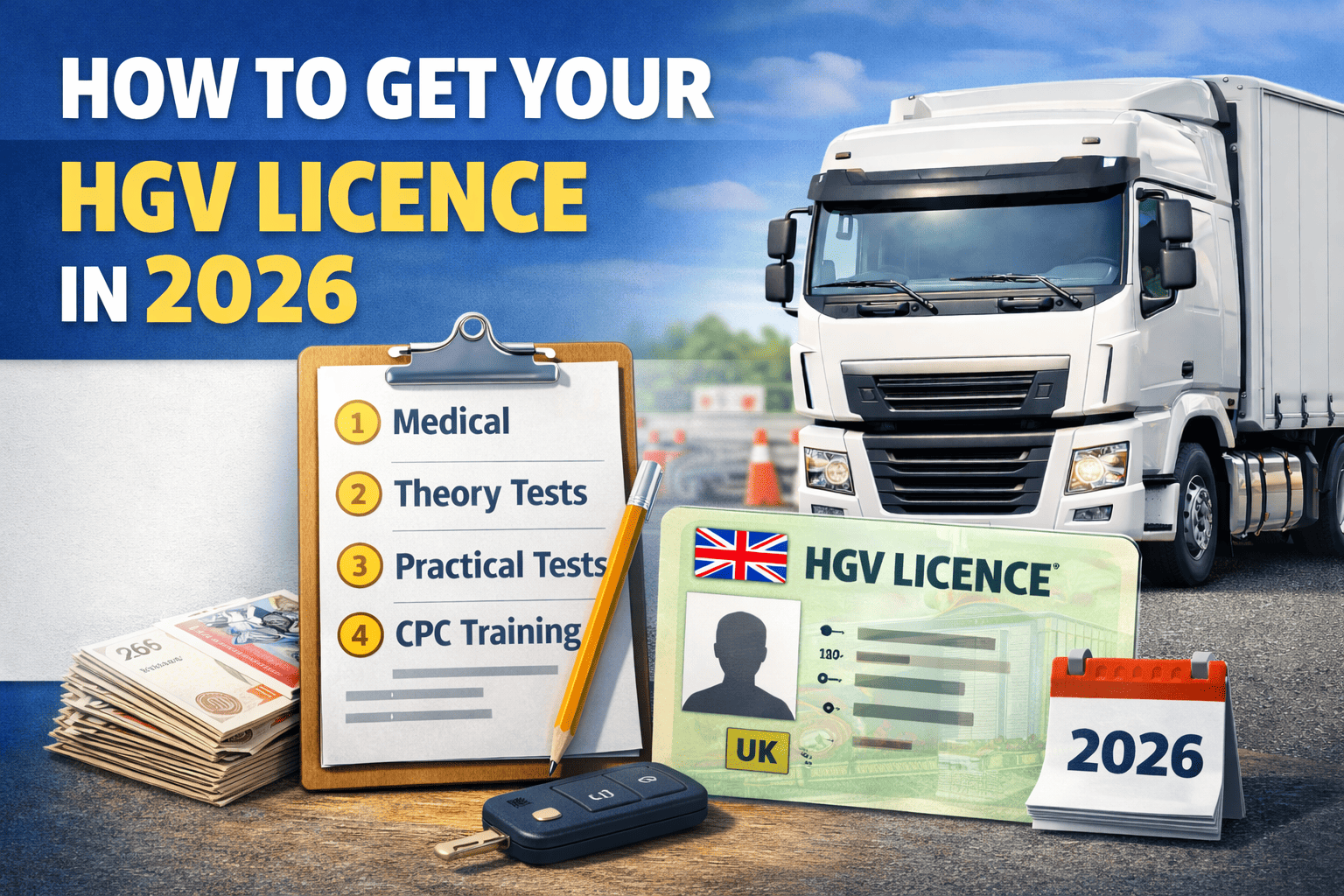
How to Get Your HGV Licence in 2026: Step-by-Step Guide (UK)
If you are looking at HGV training in 2026, you are probably asking one simple question: how do I get my HGV licence? The good news is the process is structured and achievable when you follow the steps in order.
This guide explains the full UK HGV licence process from medical and theory tests through to the practical tests and Driver CPC.
What Is an HGV Licence?
An HGV licence allows you to legally drive Heavy Goods Vehicles over 3.5 tonnes in the UK. The most common licence categories are:
- Cat C (often called Class 2): rigid lorries
- C+E (often called Class 1): articulated lorries (artics)
Many candidates now choose direct access to C+E, meaning you can train for Class 1 without first passing Cat C.
HGV Licence Requirements in the UK
Before you start, you will typically need to:
- Be at least 18 years old
- Hold a full UK car driving licence
- Meet the medical standard for driving large vehicles
You do not need previous lorry experience. Most people start from scratch with structured HGV training.
Step 1: Complete Your HGV Medical (D4)
The first step is your HGV medical. This involves completing the D4 medical form with a doctor, who checks eyesight, blood pressure, and general health.
Once completed, you submit your D2 application and D4 medical to the DVLA to apply for provisional entitlement. When approved, your licence will show provisional Cat C or C+E.
Step 2: Pass the HGV Theory Tests
Before you can move onto practical HGV training, you must pass the theory stage. This typically includes:
- Module 1a: multiple choice theory
- Module 1b: hazard perception
If you plan to drive professionally, you will also need Driver CPC theory:
- Module 2: CPC case studies
You must pass Modules 1a and 1b before you can take the practical driving tests.
Step 3: Start Practical HGV Training
After theory is passed, you can begin practical HGV training. Course lengths vary depending on licence type and experience. As a rough guide:
- Cat C training often runs over 4 to 5 days
- C+E training often runs over 5 to 7 days
Your training should cover vehicle control, road positioning, safe use of mirrors, junctions and roundabouts, and test standard driving. You will also practise the manoeuvres required for the off-road test.
Step 4: Pass the HGV Practical Tests (3A and 3B)
Module 3A: Off-road reversing
Module 3A is completed at an approved test site in a controlled environment. It assesses your ability to reverse accurately and safely. If you are training for C+E, it may also include an uncouple and recouple exercise.
Module 3B: On-road driving test
Module 3B is the on-road DVSA driving test. The examiner will assess safe, controlled driving across a range of road types and situations, including mirrors, lane discipline, hazard awareness, and overall planning and judgement.
You must pass 3A before taking 3B. If you pass 3A but fail 3B, you normally only need to retake 3B.
Step 5: Complete Driver CPC (If Driving Professionally)
If you plan to work as an HGV driver, you will need Driver CPC. This typically includes:
- Module 2: CPC case studies (theory)
- Module 4: CPC practical demonstration test
After passing, you will receive your Driver Qualification Card (DQC), which you need to drive professionally.
How Long Does It Take to Get an HGV Licence?
Many candidates complete the full process in around 8 to 12 weeks. Timescales depend on DVLA processing and test availability. The practical training itself is usually completed within a week once everything is booked.
Choosing Between Cat C and C+E
Cat C (Class 2) is a popular starting point and suits many driving roles. C+E (Class 1) can open up more job options and higher earning potential. The best option depends on your goals, confidence level, and the type of work you want.
Common Mistakes to Avoid
- Not revising properly for the theory stage
- Choosing a provider based on price alone
- Not allowing enough time to practise reversing
- Leaving CPC too late if you plan to work professionally
Final Thoughts
Getting your HGV licence in 2026 is a step-by-step process. With structured HGV training, proper preparation for the theory and practical tests, and a clear plan, it is entirely achievable.
If you are not sure which route is right for you, speaking to an HGV training advisor can help you choose the most suitable licence and timeline.